Stéphan Barron and Sylvia Hansmann : the meridian or the fractalized line
To ask Stephan Barron why he chose the Greenwich meridian, or rather a fragment of the meridian, to perform his Lines Project is like asking Benoît Mandelbrot why he chose Brittany’s coast to achieve his fractal measuring process.
Indeed, the meridian project by Stephan Barron and his friend Sylvia Hansmann is based on both active and passive concepts as well as mental and practical measurements. The Greenwich meridian is taken as it enters Europe, i.e. at Villers-sur-Mer, and the process ends in Spain, at Castellon de la Plaña, the line having gone across France from sea to sea. It is punctuated by samplings of landscape, so to speak, or by shots of landscape at different locations, and by transmitting them by fax to eight museums that are, as it were, the fractalizing projectors of the process, the process aims, as Stephan Barron says, to induce a mental image of this line, i.e. a measured fragment of the meridian. To ensure the measuring will achieve its purpose, it needs to transcend its practical aspect.
The measuring is only actual measurement insofar as it is perceived as a tangible phenomenon of the line by the transmitters of the messages/markers as much as by those who receive the faxes. The fact that a fragment of the line is transmitted thus means a part is considered to be a whole in itself by those receiving the messages.
This process also has the characteristics of a sentimental journey, of discovery, of a route with all the unforeseen and intense moments that come into play on an existential level. | 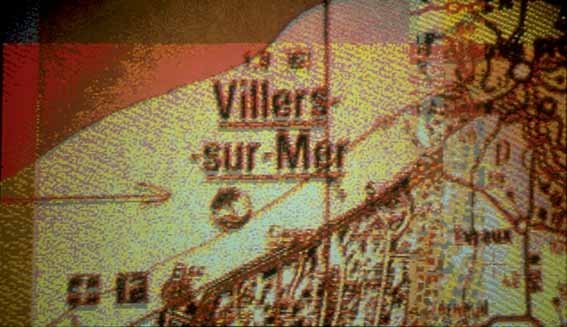 |
Barron is extremely aware of the composite aspect of the project’s basic references, but I think that the problem of reference multiplicity is a relatively minor one. More important is the phenomenon of perception, and beyond it, the sensitivity which can encompass a planetary scale and the sense of the world as an object to be measured, this through the proper extension of its inner strengths.
I think the young artists of Barron’s generation are by force of circumstance destined to a synthesis of reference that allows them to verify norms of language. Barron and Hansmann’s experience seems to me typical of a moment as well as of a need.
The moment is one of change from the industrial age to the post-industrial society, and the need one of insertion into a sensibility capable of transcending the statements of modernity and satisfying post-modern conditions. What seems most important and determinant to me in this kind of project is that it is recording the unique nature of our time, and a will to assume it through perceptions that endlessly echo a given situation in time, that create this kind of fate of the identical which involves the normality of our differences, both big and small.
Barron and Hansmann have their whole life ahead of them, but I think that this operation, which they will realize serves as the initial step in a more involved process, occurs at a very precise moment in a time of wavering values, as Lyotard has put it, and broaches in essential, fundamental, and structural terms, the subject of measurement, i.e. measurement of space and time, of man in relation to his environment, of man in relation to his ability to communicate, which involves the use of certain instantaneous communication technologies, which moreover make obvious that measurement alone is not an end in itself but rather an adventure of human perception. It is this sense of the human adventure that makes Barron and Hansmann’s project a performance unlike others, one unrelated to an ironic sense of relativity. It is really measurement with a double meaning: on the one hand there’s the extroverted meaning of objective realization along with the communication of this realization, and there’s the introverted meaning of the operation’s perception on the other.
I think that we will be led in future years to consider this phenomenon as a sort of ef゙cient morality of perception as opposed to a gratuitous hotchpotch. It is absolutely essential that we learn to globalize our concepts, our feelings and our actions. Measurement is itself the yardstick for this global perception and I think that with the passing of time, Barron and Hansmann’s processes will appear logical and illuminating in regards to the present trend of omnidirectional research that has become so typical of our collective consciousness.
Because of the entire project’s logical simplicity, there may be a tendency towards a certain ordinariness, but this ordinariness is an intelligent and valuable one. In a way, Stephan Barron and Sylvia Hansmann may have reinvented the wheel, however, the return to this kind of essential and basic fact tallies with the necessities of the present and helps us forge the instruments of our new knowledge.
The faxes that have been gathered at the different reception points–museums that have punctuated the mental stretch of the line–constitute the fractalization of this very line and the beginning of a similar, infinite process that can repeat the image of this part of the whole: this is the way we must think of the simple acts that renew our perception and give it a human and emotional quality that is eternally renewed and renewable.
Pierre Restany
Paris, 13 March, 1990